Home














SUSTAINABLE HISTORY
Prof. Nayef Al-Rodhan's Books, Articles, Theories, Concepts, Quotes, Aphorisms and Other Publications.
Professor Nayef Al-Rodhan FRSA is a transdisciplinary philosopher, neuroscientist, geostrategist and futurologist.
He is an Honorary Fellow of St. Antony's College, Oxford University; Head of the Geopolitics and Global Futures Department at the Geneva Center for Security Policy in Switzerland; Senior Research Fellow at the Institute of Philosophy, School of Advanced Study, University of London; Member of the Global Future Councils at the World Economic Forum; and Fellow of the Royal Society of Arts (FRSA).He is also the intellectual founder of the Transdisciplinary Philosophy movement, which bridges and transcends traditional academic boundaries while addressing fundamental questions across the breadth of philosophy as it interacts with other disciplines and 21st Century concerns.
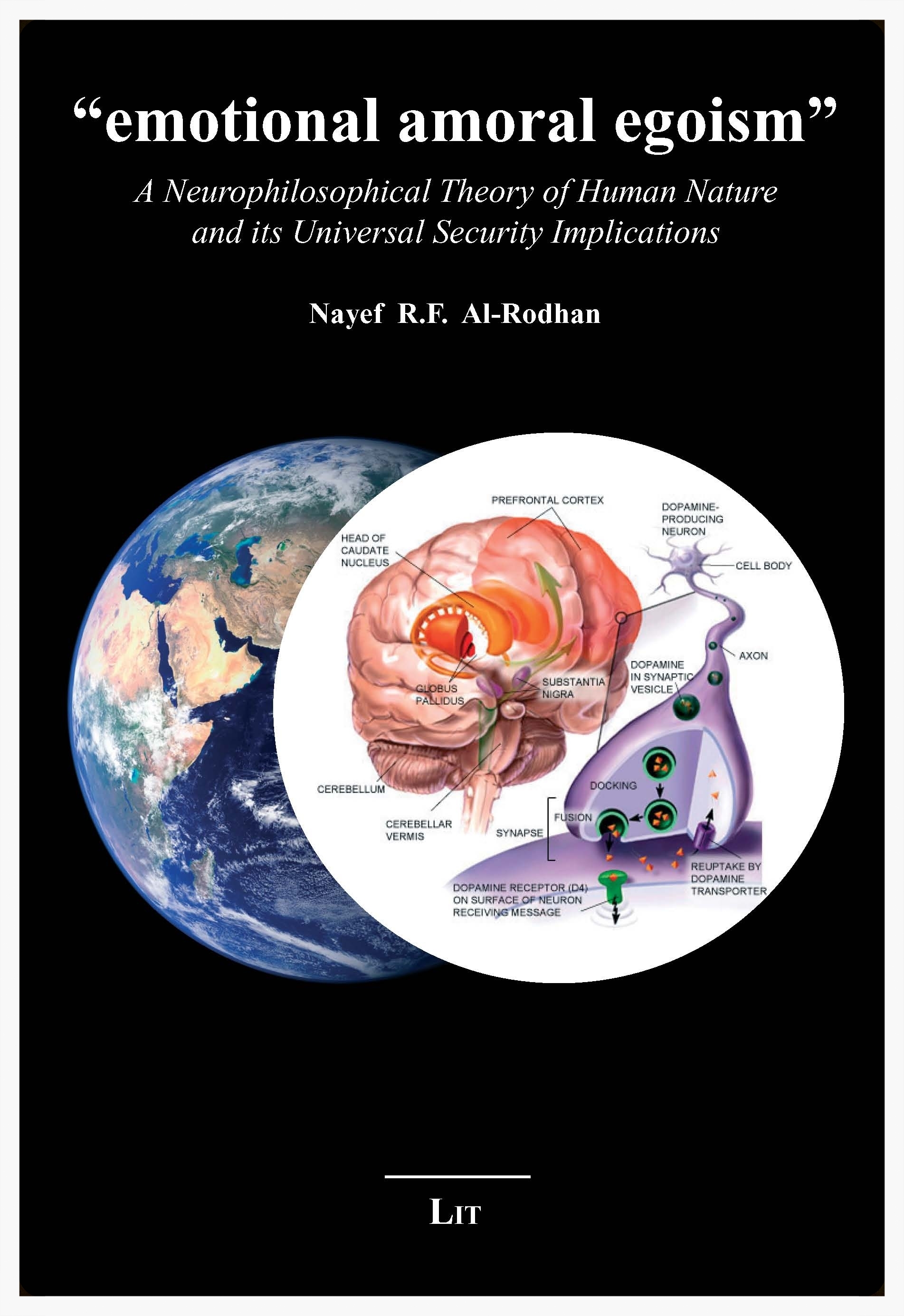
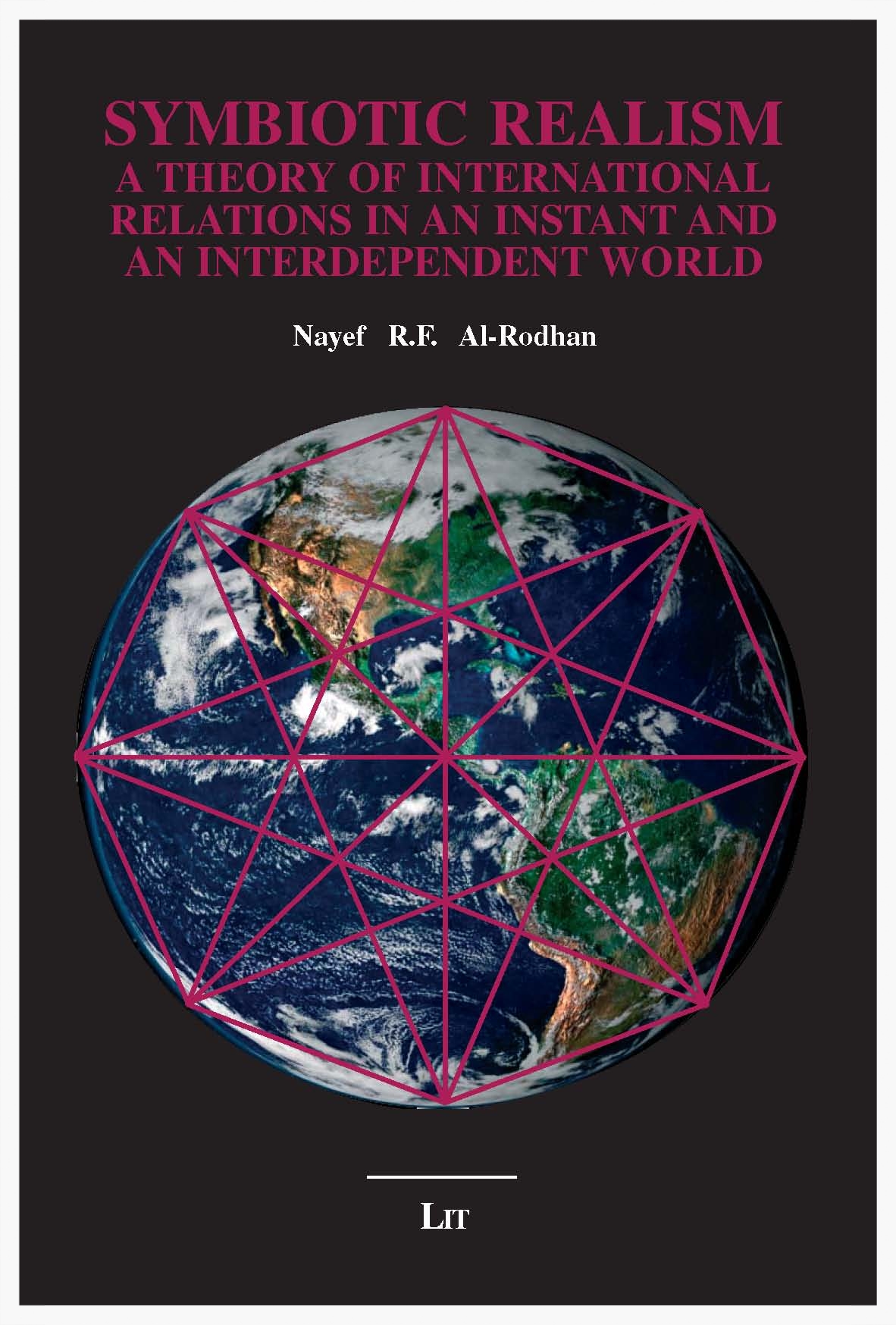
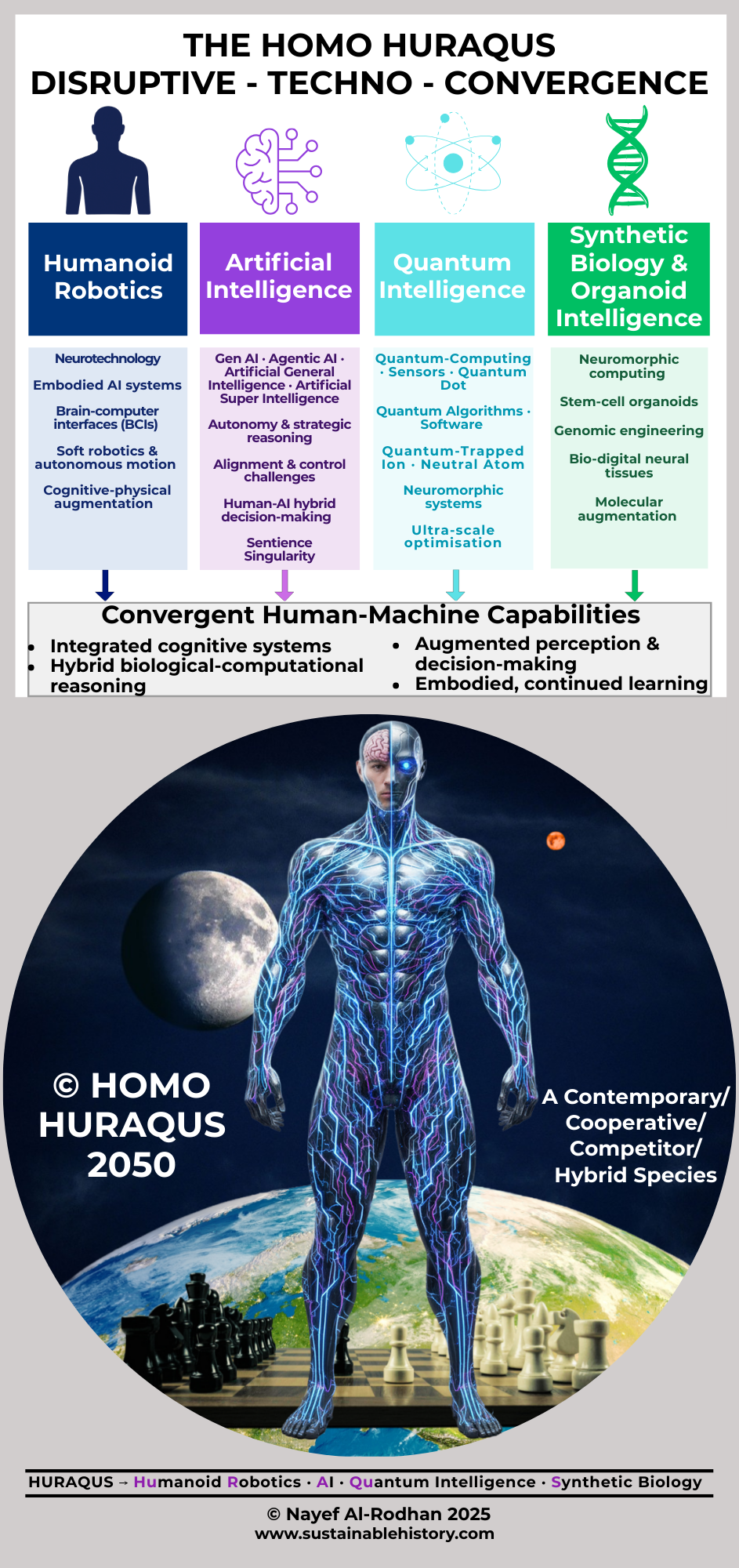
Prof. Al-Rodhan is a prize-winning scholar who has written more than 350 articles and 25 books, including most recently 21st-Century Statecraft: Reconciling Power, Justice And Meta-Geopolitical Interests, Sustainable History And Human Dignity, Emotional Amoral Egoism: A Neurophilosophy Of Human Nature And Motivations, and On Power: Neurophilosophical Foundations And Policy Implications. His research focuses on transdisciplinarity, neuro-techno-philosophy, and the future of philosophy, with a particular emphasis on the interplay between philosophy, neuroscience, strategic culture, applied history, and geopolitics, on Earth and in Outer Space. His current projects are also focused around Geopolitical Realities, Geostrategic Imperatives, Collective Civilisational Frontier Risks, Outer Space Security, Safety and Sustainability, Disruptive Technologies (Generative AI, Synthetic Biology, SuperIntelligence), National and Global Security, Political Theory and International Relations, with his transdisciplinary 'Symbiotic Realism' framework describing the seven new forces transforming the international system.
INTERVIEW

Grand Strategy

Neuro-Techno-Philosophy
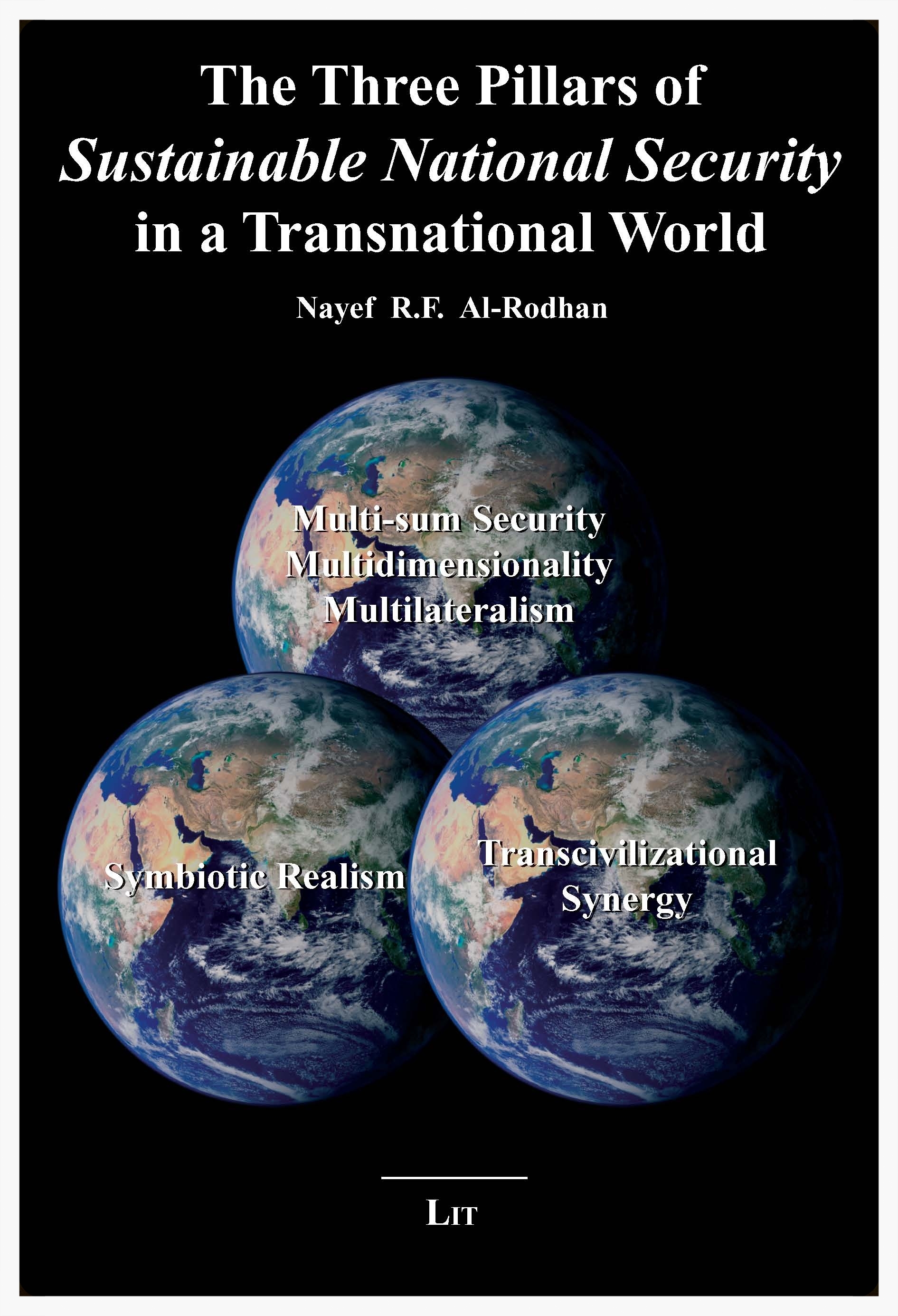
Symbiotic Realism
Recent articles on the Symbiotic Realism theory:
Symbiotic Realism: A Transdisciplinary International Relations theory
Symbiotic Realism: A Transdisciplinary International Relations theory (extended version)
Sustainable History propelled by good governance
Emotional Amoral Egoism
The Ocean Model of Civilization
Neuro-P5
Transcultural Synergy and universal axiology
The necessary prerequisites of sustainable history
Reconciliation statecraft: reconciling the eight global interests
Pre-requisites of the triumph of individual geo-cultural domains
Read more:
Minimum criteria of human dignity needs
Just power
multi-sum security principle
LATEST ARTICLES








Letter: Planetary Scale GeoEngineering Also Need their Own Governance.
May 2026 - Financial Times

OuterSPACE and AI - the FINAL FRONTIER
March 2026 - GCSP

OuterSPACE and AI - the FINAL FRONTIER
March 2026

Outer Space Ethics, Space Fertility and Space Travel
February 2026


Unlocking Human Capacity for Equitable Peace in an Anarchic and Hierarchical World:
A TransDisciplinary Analysis of my Sustainable Global Security Theory
September 2025 - E-International Relations
Letter in The Times: Life on Mars by 2040?; A bold vision - but at what cost?
June 2025 - The Times

‘Trump’s Golden Dome Creates Opening for Space Force to Gain Relevance’
June 2025 - Bloomberg

Symbiotic Realism: a transdisciplinary approach to understanding international relations
May 2025 - Frontiers in Political Science
April 2025 - American Philosophical Association (APA)
The Transdisciplinary Philosophy Imperative: Safeguarding The Future of Humanity -
A Manifesto by Nayef Al-Rodhan
March 2025 - www.sustainablehistory.com

Transdisciplinary philosophy: An interview with Professor Nayef Al-Rodhan
March 2025 - Research Outreach

March 2025 - Oxford Public Philosophy (OPP)

We Need A TransDisciplinary Coalition To Create Responsible AI – A Symbiotic Realist Framework
February 2025 – Munich Security Conference

The new space age needs a new politics
November 2024



AI, War and Transdisciplinary Philosophy
November 2023

Interview - Recently Published Book Spotlight: Sustainable History and Human Dignity
August 2023 - APA Blog
How do we predict which ideas pass the test of time?
August 2023 - The Montreal Review

Transdisciplinary philosophy and public policy
June 2023 - Research Features
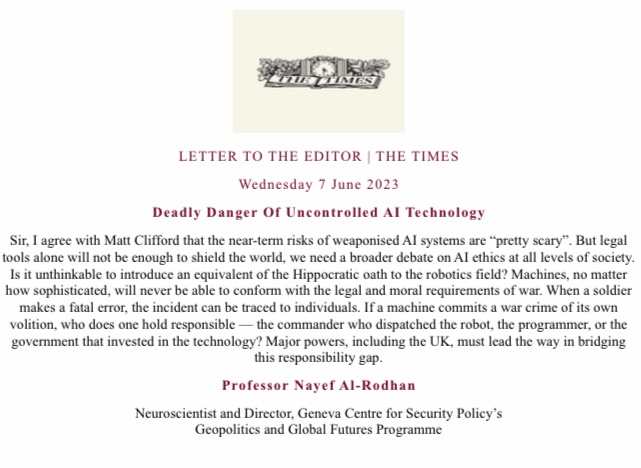
Letter: Deadly Danger Of Uncontrolled AI Technology
June 2023 - The Times
What could ‘public philosophy’ do for philosophy today?
June 2023 - Oxford Public Philosophy
Research Features: “The Future of Philosophy is Transdisciplinary”
Commentary on My NeuroTechnoPhilosophy Framework in Research Features May 2023
Letter: ‘Ethical’ AI Inspections
March 2023 - The Times

Meta-Geopolitics: A holistic approach to geopolitics
March 2023 - Centrum Balticum

February 2023 - Philosophy in Review

Preventing the Increased/Uncontrolled Militarisation of Outer Space
February 2023 - GCSP

The critical interplay between cybersecurity and outer-space security
February 2023 - The Security Times
Letter: Tread warily before using avatars as grief counsellors
January 2023 - Financial Times
December 2022 - The Times
Maritime Security: Piracy in the Gulf of Guinea
December 2022 - GCSP

Statement at UNHQ: Geopolitics, Governance, Security and Sustainability in Outer Space
October 2022 - United Nations

Transdisciplinarity, neuro-techno-philosophy, and the future of philosophy
November 2022 - Metaphilosophy

Lessons from Dr Strangelove: How To Avoid Nuclear War
October 2022 - Modern Diplomacy
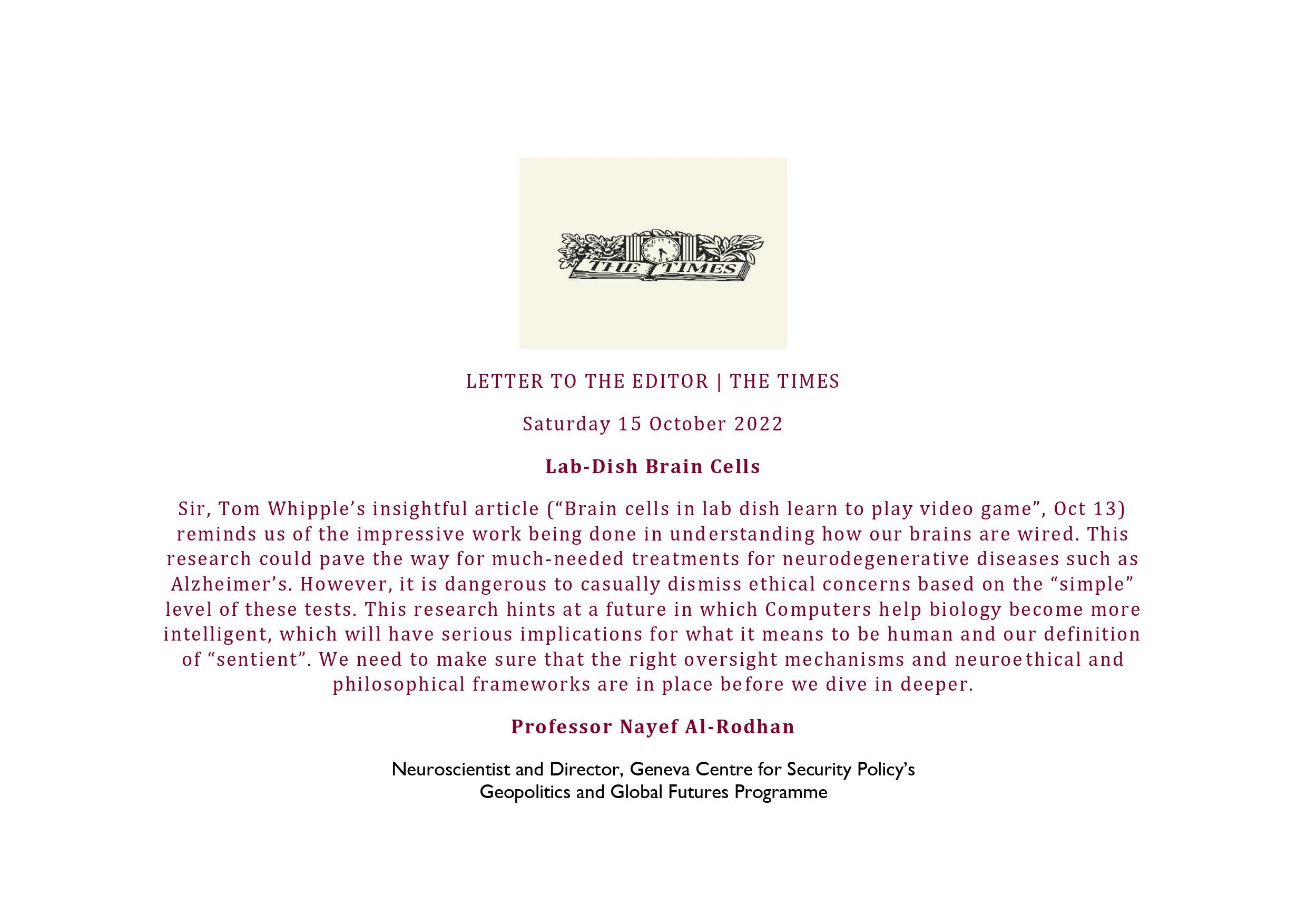
October 2022 - The Times

How do we set the moral compass on AI-generated art?
October 2022 - CAPX

The wrongs, harms, and ineffectiveness of torture: A moral evaluation from empirical neuroscience
October 2022 - Journal of Social Philosophy
We must address the glaring gaps in space law
September 2022 - Reaction
The Race for AI, Quantum Supremacy
August 2022 - Modern Diplomacy
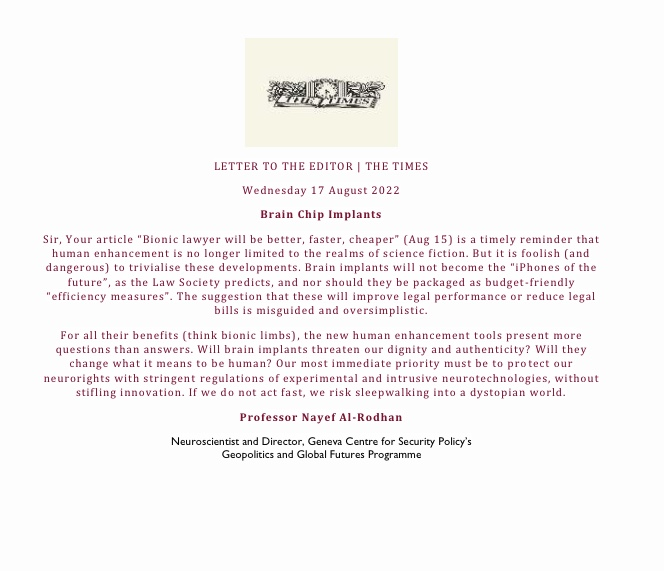
August 2022 - The Times
Microchips: why it’s time to start thinking ahead
August 2022 - CAPX
Regulate outer space before it is too late
July 2022 - Modern Diplomacy
Measuring chaos: why the world needs a dignity index
June 2022 - CAPX
How do you make killer robots act ethically?
June 2022 - Reaction
February 2022 - The Times

The Rise of Neurotechnology Calls for a Parallel Focus on Neurorights
May 2021 - Scientific American

Working from Home: A Neuroscientific Perspective
May 2021 - Areo

Emotions, Politics and Vaccines
March 2021 - EU Observer

Artificial Intelligence: Implications for human dignity and governance
March 2021 - Oxford Political Review

February 2021 - New Philosopher
Implications of New Space Forces for Sustainable Space and Terrestrial Security
February 2021 - Global Policy

Global navigation satellite systems: a Symbiotic Realist paradigm
February 2021 - The Space Review
What will space security look like in 2021?
January 2021 - The Space Review


Finding a common ground for international space regulation
January 2021 - The Parliament

3 disruptive frontier risks that could strike by 2040
December 2020 - World Economic Forum
In space, either we all win, or we all lose
October 2020 - The Parliament
Why agile governance should be human-centred governance
September 2020 - World Economic Forum
Covid-19 has shown the world is not prepared for potential bioweapons
September 2020 - CAPX
A Neurophilosophy of Autonomous Weapons and Warfare
August 2020 - APA


Private against public: Is Britain’s move into OneWeb the start of a new space race?
July 2020 - Emerging Europe

Seven Substrates for a Symbiotic, Secure and Sustainable Global Future
July 2020 - Cooperative Security Initiative

La neuro-philosophie et le transhumanisme
July 2020 - La-Philo
Major Transformative Technologies and the Five Dimensions of Security
June 2020 - Oxford Political Review
June 2020 - Global Policy

Une neuro-philosophie de la compréhension transculturelle mondiale
May 2020 - Les Philosophes.fr
Meta-Geopolitics of Pandemics: The Case of Covid-19
May 2020 - Global Policy

A Neurophilosophical Paradigm for a New Enlightenment
May 2020 - CSS

Why now is the time for universal basic income
April 2020 - The New European

A Neurophilosophy of Power and Constitutionalism
April 2020 - APA
Social Distancing: A Neurophilosophical Perspective
April 2020 - Aero
April 2020 - Les Philosophes.fr
COVID-19 could dramatically change the way we see government
March 2020 - Reaction
A Neurophilosophical paradigm for a new Enlightenment
March 2020 - APA

February 2020 - Les Philosophes.fr

January 2020 - DATAFLOQ

In 2020, we need to think of a #UN for the 21st century
December 2019 - EU Reporter
A Neurophilosophy of Conflict, War, and Peace
December 2019 - APA
The Runaway Train of Cognitive Enhancement
December 2019 - Scientific American
Nato and EU: cooperate, not compete, on space security
December 2019 - EU Observer


An Eye for AI May Leave the Whole World Blind
November 2019 - DATAFLOQ

A Neurophilosophy of Global Trans-cultural Understanding
October 2019 - ETH Zurich

Facebook vs. democracy: Let’s get serious about disinformation
October 2019 - City A.M.
October 2019 - World Economic Forum
October 2019 - EU Reporter

A Neurophilosophy of global trans-cultural understanding
September 2019 - APA

The Upcoming Space Race and Weaponization of Space
September 2019 - Independent

The Future of Meta-Geopolitical Competition in Outer Space
July 2019 - ISPI
June 2019 - CSS ETH Zurich


How understanding the five motivators of humankind will help us to improve the world and ourselves
May 2019 - World Economic Forum

May 2019 - New Philosopher


Free Will in the Age of Neuromodulation
El libre albedrío en la era de la neuromodulación
October 2018 - OpenMind

A Neuro-Philosophy of History: “Sustainable History”; with Dignity, and without Directionality
September 2018 - ETH Zurich


This is what mind-altering drugs and technology mean for free will
July 2018 - World Economic Forum

Free Will in the Age of Neuromodulation
July 2018 - Philosophy Now


Sustainable Governance of Future Outer Space Colonies
June 2018 - ETH Zurich

Quantum Computing and the New Space Race
June 2018 - The National Interest

June 2018 - OXPOL


This is Your Brain on Mars: What Space Travel Does to Our Psychology
May 2018 - ETH Zurich

US Space Policy and Strategic Culture
April 2018 - OXPOL


What Will Space Exploration Look Like In The Future? – Analysis
April 2018 - Eurasia Review
Emotional Amoral Egoism and its Implications for Understanding Conflicts
April 2018 - Global Policy
Space traffic control: technological means and governance implications
April 2018 - The Space Review

U.S. Space Policy and Strategic Culture
April 2018 - Journal of International Affairs

Artificial Intelligent Agents: Prerequisites for Rights and Dignity
April 2018 - CSS ETH Zurich

What will space exploration look like in the future?
March 2018 - World Economic Forum

Preventing Future Conflicts in Outer Space
March 2018 - CSS ETH Zurich


Weaponization and Outer Space Security
March 2018 - Global Policy

March 2018 - Eurasia Review

The Seven Capacities of States: a Meta-Geopolitical Framework
March 2018 - Georgetown Journal of International Affairs

Artificial Intelligent Agents: Pre-requisites for rights and dignity
March 2018 - Age of Robots

March 2018 - Eurasia Review

Emotional Amoral Egoism and its Implications for Understanding Conflicts
February 2018 - E-IR

This is your brain on Mars: what space travel does to our psychology
February 2018 - Prospect

February 2018 - YaleGlobal Online

Why technological Innovation and increased cooperation regarding space debris are vital
February 2018 - The Space Review

Russia: Space Power And Strategic Culture – Analysis
February 2018 - Eurasia Review

China Aims for the Moon - and Beyond
February 2018 - The Diplomat

Brainprints: Implications for Security and Civil Liberties
February 2018 - The Fletcher Forum of World Affairs

Future of Human Enhancement - What is the future of human enhancement in the Arab World?
February 2018 - World Economic Forum

Reconciliation Statecraft: Eight competing principal interests
February 2018 - ETH Zurich

Reconciliation Statecraft: Eight competing principal interests
February 2018 - Global Policy

Interview: Symbiotic Realism and the Emotionality of States
October 2017 - Global Affairs Mexico


Post-Truth Politics, the Fifth Estate and the Securitization of Fake News
June 2017 - ETH Zurich

June 2017 - Global Policy
Post-Truth Politics, the Fifth Estate and the Securitization of Fake News



The 'Ocean Model of Civilization', Sustainable History Theory, and Global Cultural Understanding
May 2017 - British Academy

Tomorrow's arsenal: Two authors probe the technologies transforming warfare
December 2016 - Science


Divisive Politics and the Brain: Primordial Determinism vs. Responsible Egalitarianism
October 2016 - Global Policy

Us versus Them. How neurophilosophy explains our divided politics
October 2016 - OXPOL

Us versus Them. How neurophilosophy explains our divided politics
October 2016 - ETH Zurich

Us versus Them. How neurophilosophy explains our divided politics
October 2016 - World Economic Forum

Moral Enhancement: A Reality Check
September 2016 - Los Angeles Review of Books
Review of 'The Myth of the Moral Brain: The Limits of Moral Enhancement' by Harris Wiseman.

The neuro-philosophy of international relations
August 2016 - OXPOL
Implications for Sustainable Peace and Security.
![August 2016Neuro-philosophy of International RelationsNeuroscience has had limited disciplinary connectivity to the field of International Relations (IR) and Politics. The field of IR is traditionally understood [...] Read more.](https://images.squarespace-cdn.com/content/v1/52dfc9b0e4b001080044aaf9/1518168319453-BCP78P6YZRGAJC6XESCB/bbva+logo+squarespace.png)
Neuro-philosophy of International Relations
August 2016 - OpenMind
Neuroscience has had limited disciplinary connectivity to the field of International Relations (IR) and Politics. The field of IR is traditionally understood [...].
![August 2016La neurofilosofía de las relaciones internacionalesEl vínculo disciplinar entre neurociencia y relaciones internacionales y política es limitado. Tradicionalmente, se entendía [...] Lee mas.](https://images.squarespace-cdn.com/content/v1/52dfc9b0e4b001080044aaf9/1518168346565-G0VBURTAUIU6GH83UVXI/bbva+logo+squarespace.png)
La neurofilosofía de las relaciones internacionales
August 2016 - OpenMind
El vínculo disciplinar entre neurociencia y relaciones internacionales y política es limitado. Tradicionalmente, se entendía [...].

La optogenética ilumina la neurociencia terapéutica
June 2016 - Scientific American
Realzada por microchips inalámbricos emergentes, la técnica podría ofrecer nuevas rutas para el tratamiento de enfermedades como el párkinson y la depresión.

Neuro-Philosophy of International Relations
June 2016 - ETH Zurich
Implications for Sustainable Peace and Security.

Organs-on-Chips Allow New Views of Human Biology
June 2016 - Scientific American

Optogenetics Lights Up Therapeutic Neuroscience
June 2016 - Scientific American

The computer chip that thinks it's a tiny human liver
June 2016 - World Economic Forum

A brain breakthrough that offers new hope for Parkinson's and Depression
June 2016 - World Economic Forum

Behavioral Profiling and the Biometrics of Intent
June 2016 – Harvard International Review
Security vs. Orwellian infringement on Civil Liberties.

Neuro-Philosophy of International Relations
June 2016 - The Montreal Review
Implications for Sustainable Peace and Security.

La selección natural de las ideas: Requisitos e implicaciones en política, filosofía e historia
June 2016 - BBVA OpenMind
¿Por qué algunos paradigmas e ideas perduran mientras que otros se quedan obsoletos o se rechazan?

The Natural Selection of Ideas: Prerequisites and Implications for Politics, Philosophy and History
June 2016 - BBVA OpenMind
Why do certain ideas and political paradigms endure while others become obsolete or are rejected?

The Natural Selection of Ideas: Prerequisites and Implications for Politics, Philosophy and History
May 2016 - ISN Blog, ETH Zurich
Why do certain ideas and political paradigms endure while others become obsolete or are rejected?

The Natural Selection of Ideas: Prerequisites and Implications for Politics, Philosophy and History
May 2016 - Global Policy Journal
Why do certain ideas and political paradigms endure while others become obsolete or are rejected?

Neuromorphic Computers: What will they Change?
February 2016 - Global Policy Journal

Proposal of a Dignity Scale for Sustainable Governance
January 2016 - The Oxford University Politics Blog

Propuesta de una escala de dignidad para un gobierno sostenible
January 2016 - BBVA OpenMind
La dignidad es fundamental para gobernar bien.

Proposal of a Dignity Scale for Sustainable Governance
January 2016 - BBVA OpenMind

Proposal of a Dignity Scale for Sustainable Governance
December 2015 - ISN Blog, ETH Zurich

Hypersonic Missiles Offer Some Impressive- and Disturbing- Capabilities
December 2015 - OxPol
Hypersonic missiles offer some impressive- and disturbing- capabilities.

Proposal of a Dignity Scale for Sustainable Governance
November 2015 - Journal of Public Policy
Why dignity is critical to good governance.

Hypersonic Missiles and Global Security
November 2015 - ISN Blog, ETH Zurich
Hypersonic missiles offer some impressive- and disturbing- capabilities.

Hypersonic Missiles and Global Security
November 2015 - The Diplomat
Hypersonic missiles offer some impressive- and disturbing- capabilities.

The Tripwire Pivotal Corridor Conflicts
October 2015 - Geneva Centre for Security Policy
Within the Tripwire Pivotal Corridor (TPC) are several politically unstable regions that have a great importance for global security.

Socioneurobiología y perspectivas para nuestro futuro colectivo global
Setiembre 2015 - BBVA OpenMind
Aunque en los últimos años el estudio del comportamiento social humano ha cobrado impulso, sus aspectos biológicos y evolutivos siguen siendo poco explorada .

Socio-Neuro-Biology and Prospects for Our Collective Global Future
September 2015 - BBVA OpenMind
Although in recent years the study of human social behaviour has gained momentum, its biological and evolutionary aspects remain underexplored.

The Moral Code: How to Teach Robots Right and Wrong
September 2015 - ISN Blog, ETH Zurich
As robots are becoming more autonomous, we must begin to reflect on their capacity for moral reasoning.

The Privatization of Space: When Things Go Wrong
August 2015 - ISN Blog, ETH Zurich
As space explorations begins to depend more heavily on private companies, one must look at how this changes the role that governments play. Read More.

The Moral Code: How to Teach Robots Right and Wrong
August 2015 - Foreign Affairs
As robots are becoming more autonomous, we must begin to reflect on their capacity for moral reasoning.

Socio-Neuro-Biology and Prospects for Our Collective Global Future
July 2015 - E- International Relations
Although in recent years the study of human social behaviour has gained momentum, its biological and evolutionary aspects remain underexplored.

Strategic Culture and Pragmatic National Interest
July 2015 - Global Policy Journal
How the study of strategic culture remains important for understanding and addressing conflicts in an interdependent world.

The "Emotional" Amoral Egoism of States
July 2015 - Global Policy Journal
Why states don't always behave as rationally as we may expect them to.

The "Emotional" Amoral Egoism of States
July 2015 - ISN Blog, ETH Zurich
Why states don't always behave as rationally as we may expect them to.

Brain Gain: The Emerging Security and Ethical Challenges of Cognitive Enhancement
July 2015 - Georgetown Journal of Foreign Affairs
Explores the implications of Cognitive Enhancement.

The Emotional Amoral Egoism of States
June 2015 - OXPOL - Politics in Spires
Why states don't always behave as rationally as we may expect them to.

Future Wars: Reshaping the Ethics and Norms of War
June 2015 - Wilson Quarterly
Technology's forward march will require us to reconsider and even rewrite the rules of war.

Rationality, Pragmatism, and Palestine
June 2015 - Diplomatic Courier
Emotions have long played a central role in the Israeli-Palestinian conflict.

What Does Nanotechnology Mean for Geopolitics?
June 2015 - World Economic Forum Blog

The "Emotional" Amoral Egoism of States
June 2015 - The Montréal Review
Why states don't always behave as rationally as we may expect them to.

May 2015 - ISN Blog, ETH Zurich
Exploring the implications of the development and acquisition of human enhancement technologies for military purposes.

May 2015 - Global Policy Journal
Exploring the implications of the development and acquisition of human enhancement technologies for military purposes.


Symbiotic Realism and Just Power
April 2015 - OpenDemocracy
Four interlocking elements shape the global system : the neurobiological substrates of human nature, global anarchy, instant connectivity and interdependence.

April 2015 - Journal of Public Policy
Examining previously unexplored links between neurochemistry and public policy.

Security Implications and Existential Crossroads of Artificial Intelligence
April 2015 - Georgetown Journal of International Affairs
Emerging A.I. technologies must be carefully regulated because of their possible implications for ethics, security, and human existence.

Free-Wheeling Web Commentary Challenges Media's Traditional Power
March 2015 - Yale Global
Blogs continue to wield influence; governments and bloggers could coordinate on regulations to increase the potential.

What are the Ethical Implications of Emerging Tech?
March 2015 - ISN Blog, ETH Zurich
What are the ethical and regulatory challenges faced by crucial emerging technologies like Genetic Engineering and Artificial Intelligence?

The Many Ethical Implications of Emerging Technologies
March 2015 - Scientific American
Brainlike computer chips, smart pharmacology and other advances offer great promise but also raise serious questions that we must deal with now.

What are the Ethical Implications of Emerging Tech?
March 2015 - World Economic Forum Blog
What are the ethical and regulatory challenges faced by crucial emerging technologies like Genetic Engineering and Artificial Intelligence?

The Meta-Geopolitics of Geneva 1815-2015
February 2015 - ISN Blog, ETH Zurich
What geopolitical factors helped transform Geneva into a global economic and diplomatic center?

Quantum Computing and Global Security
February 2015 - Global Policy Journal
What are the implications of Quantum Computing for progress and security?

Gratificación Neuroquímica Sostenible y el Significado de la existencia
February 2015 - Open Mind
¿cuál es el sentido de la vida ?

Sustainable Neurochemical Gratification and the Meaning of Existence
February 2015 - Open Mind
What is the meaning of life, see my new article.

Who Are We: Neurochemical Man and Emotional Amoral Egoism
February 2015 - OXPOL - Politics in Spires
How our neurochemistry influences our Human Nature.

Who Are We: Neurochemical Man and Emotional Amoral Egoism
January 2015 - The Montréal Review
How our neurochemistry influences our Human Nature.

January 2015 - BBVA OpenMind
An Educational Program that promotes cultural security and understanding.


The Ethical and Security Implications of Synthetic Biology and Cognitive Enhancement
January 2015 - GCSP Editorials
Assessing the future impact of crucial emerging technologies.

A Proposed Theory of Knowledge: Neuro-Rational Physicalism
December 2014 - E-International Relations
Exploring the factors that influence how we acquire knowledge.

Minimum Criteria for Sustainable Global Governance
December 2014 - ISN Blog, ETH Zurich
Exploring the importance of the eight criteria for sustainable global governance.

November 2014 - Global Policy
We need a globally inclusive educational program that promotes cultural security and understanding.

Will Biology Change What it Means to Be Human?
November 2014 - World Economic Forum
The latest scientific advances will soon enable us to take charge of evolution itself.

The Geopolitics of Europe: 1815-2015
November 2014 - ISN Blog, ETH Zurich
Reexamining the last 200 years of the Geopolitics of Europe and why we need to apply a Meta-Geopolitical framework for today.

Eight Substrates for a Possible Universal Axiology
October 2014 - E-International Relations
Essentialism in one of the biggest threats to inter-cultural understanding.

Emerging Technologies: Security and Regulatory Concerns
October 2014 - ISN Blog, ETH Zurich
New security technologies require urgent oversight.


Programmable Matter: 4D Printing's Promises and Risks
October 2014 - Georgetown Journal of International Affairs
The future of fabrication.
The Social Contract 2.0: Big Data and the Need to Guarantee Privacy and Civil Liberties
September 2014 - Harvard International Review
Why in this age of big data and surveillance, privacy and civil liberties need to be protected more than ever.

The Social Contract 2.0: Big Data and the Need to Guarantee Privacy and Civil Liberties
September, 2014 - Politics in Spires
Why in this age of big data and surveillance, privacy and civil liberties need to be protected more than ever.

El Contrato Social 2.0: Big Data Y La Necesidad De Garantizar La Privacidad Y Las Libertades Civiles
September, 2014- BBVA OpenMind
Por qué en esta época de grandes datos y la vigilancia, la privacidad y las libertades civiles deben ser protegidos más que nunca.

The Social Contract 2.0: Big Data and the Need to Guarantee Privacy and Civil Liberties
September, 2014- BBVA OpenMind
Why in this age of big data and surveillance, privacy and civil liberties need to be protected more than ever.

Reforming Democracy and the Future of History
August, 2014- BBVA OpenMind
To spread Democracy, democratic nations must look inward first.

La Reforma De La Democracia Y El Futuro De La Historia
August, 2014- BBVA OpenMind
Difundir la Democracia, las naciones democráticas deben mirar hacia adentro primero.

The Islamic World and the West: Recovering Common History
August, 2014- ISN Blog, ETH Zurich
Europe overlooks long history of good exchanges with Arab-Islamic world and encourages defensive posture.

The Islamic World and the West: Recovering Common History
July, 2014- Yale Global
Europe overlooks long history of good exchanges with Arab-Islamic world and encourages defensive posture.

The Geopolitics of Culture: Five Substrates
July 2014 - Global Policy
Culture has a salient geopolitical relevance in a world that defines itself by much more than diplomatic exchanges and inter-state relations.

The Geopolitics of Culture: Five Substrates
July 2014 - ISN Blog, ETH Zurich
Culture has a salient geopolitical relevance in a world that defines itself by much more than diplomatic exchanges and inter-state relations.

The Geopolitics of Culture: Five Substrates
July 2014 - Politics in Spires
Culture has a salient geopolitical relevance in a world that defines itself by much more than diplomatic exchanges and inter-state relations.

Reforming Democracy and the Future of History
June, 2014 - The Globalist
To spread Democracy, democratic nations must look inward first.
The Geopolitics of Culture: Five Substrates
June, 2014 – Harvard International Review
Culture has a salient geopolitical relevance in a world that defines itself by much more than diplomatic exchanges and inter-state relations.

Reforming Democracy and the Future of History
June, 2014- ISN Blog, ETH Zurich
To spread Democracy, democratic nations must look inward first.


Meta-Geopolitics: the Relevance of Geopolitics in the Digital Age
May, 2014 – E-International Relations
Geopolitics will always be salient to international relations because immobile geographic structures cannot be overlooked when studying the behavior of states.

May, 2014 - Global Policy
In order to sustainable plan for the long term, human dignity must be placed at the heart of foreign and security policy.

May, 2014 - BBVA OpenMind
Para planificar de manera sostenible a largo plazo, la dignidad humana debe situarse en el centro de la política exterior y de seguridad.

Synthetic Biology - What to Expect and Fear?
April, 2014 - Global Policy
The ability to create new lifeforms is promises both unlimited potential and dangerous pitfalls.

Rare-earth metals: anticipating the new battle for resources
March, 2014 - Global Policy
Natural resources are pivotal in international politics. They create patterns of cooperation, dependencies and alter balances of power.

Cloaks of Invisibility: The latest frontier in military technology
March, 2014 - Politics in Spires
Fiction and reality have meshed to incredible extents in the past decades, and it is no longer a surprise to see sci-fi-inspired inventions used in everyday life.

El Déficit de Dignidad Alimenta Las Rebeliones de Oriente Medio
September, 2013- BBVA OpenMind
¿Están las naciones árabes condenados a seguir siendo rebelde y mal gobernados ? Las razones para el optimismo se pueden encontrar si se analiza lo que desencadenó los disturbios en el primer lugar.

August, 2013- BBVA OpenMind
Tergiversaciones ubicuas y estereotipos alienantes impregnan a través de los discursos de seguridad , fusionando imágenes de una minoría extremista con las actitudes de la mayoría pacífica.

El Futuro de las Relaciones Internacionales: una Teoría del Realismo Simbiótico
2013, BBVA OpenMind
Hans Morgenthau una vez escribió que : "Las relaciones internacionales es algo que no debe darse por sentado , pero algo debe entender y ser cambiado y , más particularmente, a cambiar más allá de los límites actuales de su estructura política y la organización."
2012 - Pages 15 to 22, “An Ocean Model of Civilization”

Honored to Speak on:
"Geopolitics, Governance, Security & Sustainability in Outer Space"
At UNHQ, NY, Oct 27, Joint Panel of:
First Committee (Disarmament & International Security, C1)
&
Fourth Committee (Peaceful Use, C4)
The list of speakers is available here
Honored to be invited by the President of #UNGA to present on:
"Outer Space Governance & Sustainability"
As part of the #UNSG mandate on



Honoured to give a keynote speech on "Transhumanism and Global Security" at the Finland Defence Forces annual Round Table, Helsinki, Finland, November 2017
The McKay Interview
Interview of Professor Nayef Al-Rodhan on 22 May 2017
TAG CLOUD
FRESH TWEETS
Quote of the Week
“Democracy guarantees political freedom and rights, yet is not incompatible with marginalization, exclusion, or poverty. ”